
Effective brand management is crucial for any organization aiming for sustained growth and market leadership. In today’s dynamic business landscape, leveraging the right tools and software is no longer a luxury but a necessity. This guide delves into the world of brand management tools and software, exploring their core functionalities, applications across various industries, and their crucial role in building and maintaining brand equity.
We will examine how these tools streamline workflows, facilitate data-driven decision-making, and ultimately contribute to a stronger, more resilient brand presence.
From defining the core functionalities of these tools to exploring their integration with other business software and showcasing real-world examples of their successful implementation, we aim to provide a comprehensive overview. We’ll also look ahead at emerging trends and the impact of technologies like AI and machine learning on the future of brand management.
Defining Brand Management Tools and Software
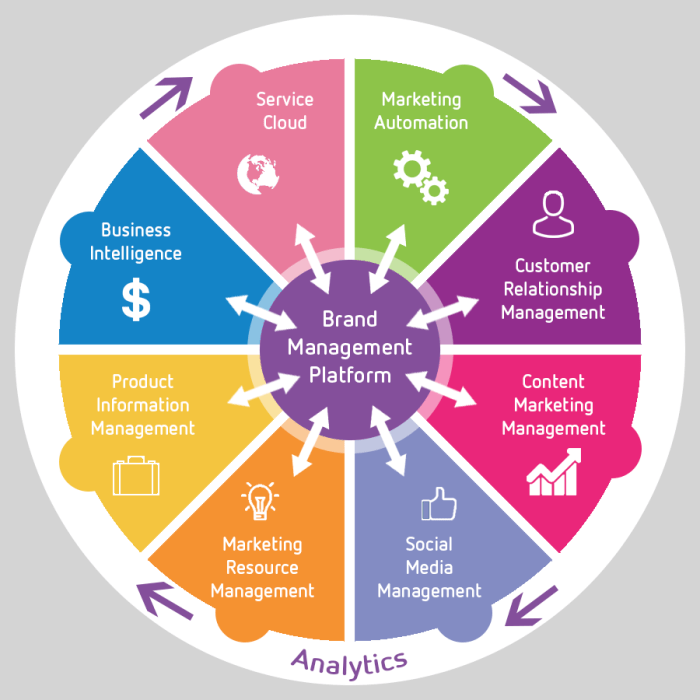
Brand management tools and software are applications designed to streamline and optimize the process of building, maintaining, and protecting a brand’s identity and reputation. They centralize brand assets, track brand performance, and facilitate consistent brand messaging across all platforms. These tools are essential for businesses of all sizes, allowing them to manage their brand effectively and efficiently.Brand management tools offer a wide array of core functionalities.
These typically include asset management (logos, fonts, imagery), brand guideline distribution and enforcement, social media monitoring, brand performance tracking (website analytics, social media engagement), and collaboration tools for internal teams and external partners. The goal is to ensure consistent brand expression and message delivery across all touchpoints.
Types of Brand Management Tools
The market offers a variety of brand management tools, each tailored to specific needs. Categorizing them helps businesses identify the best fit for their requirements.
- Digital Asset Management (DAM) Systems: These platforms primarily focus on organizing, storing, and distributing brand assets like images, videos, and documents. They ensure easy access to approved brand materials, reducing inconsistencies and saving time.
- Brand Guideline Platforms: These tools specifically manage and disseminate brand style guides, ensuring consistent application of brand identity across all marketing materials and communications. They often include features for version control and approval workflows.
- Social Media Management Tools: While not exclusively brand management tools, many offer features relevant to brand management, such as scheduling posts, monitoring brand mentions, and analyzing social media performance. This helps maintain a consistent brand voice and monitor brand reputation online.
- Marketing Automation Platforms: These platforms often integrate brand management features, allowing for personalized and consistent brand messaging across various marketing channels. They help streamline workflows and track marketing campaign performance.
- Brand Monitoring and Analytics Tools: These focus on tracking brand mentions, sentiment analysis, and overall brand health. They provide insights into consumer perception and help identify potential brand risks.
Integration with Other Business Software
Effective brand management tools seamlessly integrate with other business software for improved efficiency and data flow. For example, a DAM system might integrate with a Customer Relationship Management (CRM) system to ensure consistent brand messaging in customer communications. Similarly, brand monitoring tools can integrate with marketing automation platforms to provide real-time feedback on campaign performance and adjust strategies accordingly.
Integration with project management software allows for efficient collaboration on brand-related projects. The ability to integrate with existing business software is a crucial factor to consider when selecting a brand management tool.
Comparison of Popular Brand Management Tools
The following table compares five popular brand management tools based on features, pricing, and user reviews (Note: Pricing and reviews are subject to change and are based on general market observations at the time of writing. Individual experiences may vary).
| Tool | Key Features | Pricing Model | User Reviews (Summary) |
|---|---|---|---|
| Brandfolder | DAM, brand guidelines, workflow approvals, analytics | Subscription-based, tiered pricing | Generally positive, praised for ease of use and robust features. |
| Bynder | DAM, brand guidelines, collaboration tools, workflow automation | Subscription-based, tiered pricing | Positive reviews, highlighting strong features and integrations. |
| Widen | DAM, brand guidelines, marketing automation integration, analytics | Subscription-based, tiered pricing | Users appreciate the robust features and excellent customer support. |
| Adobe Experience Manager (AEM) Assets | DAM, workflow management, digital rights management, integration with Adobe Creative Cloud | Subscription-based, enterprise-level pricing | Powerful but complex; suitable for large organizations with significant resources. |
| Brandkit | Brand guidelines, asset management, style guide creation, team collaboration | Subscription-based, tiered pricing | Positive feedback on ease of use and intuitive interface. |
Brand Equity Measurement and Analysis using Software
Brand management software offers sophisticated tools to measure and analyze brand equity, providing valuable insights for strategic decision-making. These tools move beyond simple brand awareness surveys, offering a deeper understanding of consumer perception, brand associations, and the overall value of the brand. By quantifying these intangible assets, businesses can make data-driven decisions to enhance their brand’s performance and market position.Brand equity measurement software utilizes a variety of methods to assess the overall value of a brand.
These methods often incorporate both quantitative and qualitative data to create a comprehensive picture.
Methods for Assessing Brand Equity
Software employs several methods to assess brand equity, often combining quantitative and qualitative approaches for a holistic view. Quantitative methods rely on statistical analysis of large datasets, while qualitative methods delve into the nuanced aspects of consumer perception. For instance, some software might analyze social media sentiment to gauge public opinion, while simultaneously employing surveys to measure brand awareness and loyalty.
Other tools may use conjoint analysis to determine the relative importance of different brand attributes in consumer purchase decisions. The integration of these diverse approaches offers a more robust and nuanced understanding of brand equity than any single method could provide.
Importance of Brand Equity Metrics and Their Quantification
Different brand equity metrics provide distinct insights into various aspects of a brand’s performance. Software quantifies these metrics to provide actionable data. For example, brand awareness is measured by the percentage of consumers who recognize the brand. Brand loyalty is quantified by repeat purchase rates and customer retention. Perceived quality is often assessed through customer satisfaction scores and reviews.
Brand association is analyzed by examining the words and images consumers associate with the brand. Finally, brand differentiation is measured by comparing the brand’s unique attributes to those of its competitors. Software platforms often present these metrics visually, allowing for easy comparison and identification of areas for improvement.
Visualization of Brand Equity Data for Decision-Making
Effective visualization is crucial for translating complex brand equity data into actionable insights. Brand management software typically employs various visualization techniques, including dashboards, charts, and graphs, to present key metrics in a clear and concise manner. For example, a dashboard might display brand awareness trends over time, highlighting periods of growth or decline. Charts might compare brand perception across different demographic groups, while graphs could illustrate the relationship between brand loyalty and customer lifetime value.
This visual representation allows marketers to quickly identify strengths and weaknesses, enabling informed decisions regarding marketing strategies, product development, and brand positioning.
Case Study: Improving Brand Equity at “Coffee Crave”
Imagine “Coffee Crave,” a regional coffee shop chain. Using brand management software, they conducted a comprehensive brand equity analysis. The software analyzed customer reviews from various online platforms, revealing a strong positive association with “freshly roasted beans” but a negative association with “slow service.” The software also measured brand awareness within their region, revealing a high level of recognition but low levels of loyalty compared to competitors.
Using this data, “Coffee Crave” implemented several strategies. They launched a marketing campaign highlighting their freshly roasted beans and improved their in-store operations to reduce wait times. The software then tracked the impact of these changes, showing an increase in both customer loyalty and overall brand equity scores within six months. The visual dashboards provided clear evidence of the effectiveness of their improvements, justifying further investment in specific areas and demonstrating a clear return on investment for their brand management efforts.
Brand Strategy Development and Implementation with Software
Brand strategy development and implementation is significantly enhanced by the use of specialized software. These tools streamline processes, improve collaboration, and offer valuable data-driven insights, ultimately leading to more effective brand building. This section explores how software facilitates these crucial stages of brand management.
Key Software Features Supporting Brand Strategy Development
Effective brand strategy software provides a range of features designed to support the entire process, from initial brainstorming to final execution. These features enhance efficiency and accuracy. Crucial features often include robust project management tools, collaborative workspaces, visual brand guides, and analytics dashboards. For example, a project management module might allow for task assignment, deadline setting, and progress tracking, ensuring that all aspects of the strategy are addressed systematically.
Meanwhile, a visual brand guide ensures brand consistency across all platforms.
Comparison of Brand Strategy Implementation Approaches Using Software
Different software solutions offer varying approaches to brand strategy implementation. Some platforms prioritize a highly structured, step-by-step approach, guiding users through a pre-defined process. Others offer a more flexible, agile methodology, allowing for greater customization and adaptation as the strategy evolves. For example, a structured approach might be ideal for a large corporation with established processes, while a more flexible approach might suit a smaller, more agile organization.
The choice depends on the organization’s size, structure, and existing workflows. The key is choosing a system that aligns with the organization’s unique needs and operational style.
Software Facilitation of Collaboration in Brand Strategy Development
Collaboration is paramount in brand strategy development. Software plays a crucial role in facilitating this collaboration by providing central hubs for communication, idea sharing, and feedback gathering. Features like shared workspaces, integrated communication tools (such as chat and email), and version control systems ensure that all stakeholders are aligned and informed throughout the process. For instance, a shared workspace allows team members to simultaneously contribute to documents, presentations, and other brand assets, fostering real-time collaboration and eliminating version control issues.
This fosters a unified vision and avoids conflicting interpretations of the brand strategy.
Step-by-Step Guide to Implementing a Brand Strategy Using Software
Implementing a brand strategy effectively requires a structured approach. Software can streamline this process considerably. The following steps illustrate a typical implementation using common software functionalities:
- Define Brand Objectives: Utilize the software’s project management tools to define clear, measurable, achievable, relevant, and time-bound (SMART) objectives for the brand strategy. This ensures focus and allows for progress tracking.
- Conduct Market Research: Leverage the software’s data analysis capabilities to analyze market trends, competitor activity, and customer insights. This informs the development of a data-driven strategy.
- Develop Brand Positioning: Use collaborative workspaces to brainstorm and refine the brand’s unique selling proposition (USP) and target audience. The software’s version control features ensure all stakeholders are working with the most up-to-date version.
- Create Brand Guidelines: Employ the software’s design tools to create a comprehensive brand guide that Artikels logo usage, color palettes, typography, and brand voice. This ensures consistent brand application across all platforms.
- Implement Brand Strategy: Utilize the software’s project management tools to assign tasks, set deadlines, and track progress across various marketing channels. This ensures efficient and coordinated implementation.
- Monitor and Analyze Results: Employ the software’s analytics dashboards to track key performance indicators (KPIs) and measure the effectiveness of the brand strategy. This allows for data-driven adjustments and improvements.
Brand Equity, Brand Strategy, and Brand Management
Brand equity, brand strategy, and brand management are intrinsically linked, forming a synergistic relationship that drives a brand’s success. Understanding their interdependencies is crucial for building and maintaining a strong market position. Effective brand management relies on a well-defined brand strategy, which in turn aims to cultivate and leverage brand equity.
The Interrelationship of Brand Equity, Brand Strategy, and Brand Management
Brand equity represents the overall value of a brand, encompassing its reputation, customer loyalty, and perceived quality. Brand strategy provides the roadmap for achieving brand objectives, outlining the target audience, brand positioning, and marketing activities. Brand management encompasses the day-to-day execution of the brand strategy, ensuring consistency and effectiveness across all touchpoints. Essentially, brand strategy guides brand management, and both work in tandem to build brand equity.
Effective Brand Management’s Contribution to Brand Equity
Effective brand management directly contributes to building brand equity through consistent messaging, high-quality products or services, and excellent customer experiences. Maintaining a consistent brand voice across all platforms (website, social media, advertising) strengthens brand recognition and recall. Delivering on brand promises and exceeding customer expectations fosters loyalty and positive word-of-mouth marketing, crucial components of strong brand equity. For example, a company consistently producing high-quality products and providing exceptional customer service will naturally build a strong reputation and positive brand perception, leading to increased brand equity.
The Role of Brand Strategy in Guiding Brand Management Efforts
Brand strategy acts as the guiding principle for brand management. It defines the target audience, brand positioning, and key brand messages, providing a framework for all brand-related activities. A well-defined brand strategy ensures that all marketing and communication efforts are aligned and consistent, maximizing their impact. For instance, a brand strategy that positions a product as premium and luxurious will inform all aspects of brand management, from product design and packaging to pricing and advertising.
This ensures that the brand consistently communicates its value proposition to the target audience.
Hierarchical Structure Illustrating Interdependencies
The relationship between brand equity, brand strategy, and brand management can be visualized hierarchically. At the top is Brand Equity, the ultimate goal. Beneath it lies Brand Strategy, the roadmap to achieve high brand equity. Finally, at the base is Brand Management, the execution engine that implements the strategy and builds the equity. Each level depends on the level above it; strong brand management relies on a solid brand strategy, and a successful brand strategy ultimately aims to increase brand equity.
The process is cyclical; the results of brand management inform future brand strategy adjustments, leading to continuous improvement and growth in brand equity.
Future Trends in Brand Management Tools and Software
The landscape of brand management is undergoing a rapid transformation, driven by advancements in technology and the evolving needs of businesses. Software is becoming increasingly sophisticated, offering more integrated solutions and leveraging data-driven insights to optimize brand performance. This evolution is not just about streamlining existing processes; it’s about fundamentally changing how brands are built, managed, and measured.Emerging trends in brand management software technology are focused on enhanced integration, artificial intelligence (AI) and machine learning (ML) adoption, and a greater emphasis on data visualization and actionable insights.
This shift promises to empower marketers with unprecedented levels of control and understanding over their brand’s performance and consumer perception.
The Impact of Artificial Intelligence and Machine Learning on Brand Management
AI and ML are poised to revolutionize brand management by automating tasks, improving decision-making, and personalizing brand experiences. AI-powered tools can analyze vast quantities of data from various sources – social media, customer reviews, website analytics, and market research – to identify emerging trends, predict consumer behavior, and optimize marketing campaigns in real-time. Machine learning algorithms can personalize brand messaging and tailor customer experiences based on individual preferences and behaviors, leading to increased engagement and loyalty.
For example, a clothing retailer might use AI to analyze customer purchase history and browsing behavior to recommend personalized product suggestions, leading to higher conversion rates. Similarly, an AI-powered social listening tool can track brand mentions and sentiment across social media platforms, allowing marketers to quickly identify and address potential crises or negative feedback.
Challenges and Opportunities Presented by Future Trends
The integration of AI and ML into brand management tools presents both exciting opportunities and significant challenges. One key challenge is the need for robust data security and privacy measures. Handling vast amounts of consumer data necessitates implementing stringent security protocols to prevent data breaches and protect customer privacy. Another challenge lies in the complexity of implementing and integrating AI-powered tools into existing brand management workflows.
This requires significant investment in training and infrastructure, as well as a cultural shift within organizations to embrace data-driven decision-making. However, the opportunities are substantial. AI and ML can significantly improve efficiency, reduce costs, and enhance brand performance by providing more accurate insights, personalized experiences, and optimized marketing campaigns. The ability to predict consumer trends and proactively address potential issues can provide a competitive advantage and help brands stay ahead of the curve.
Anticipated Evolution of Brand Management Software in the Next Five Years
A visual representation of the anticipated evolution of brand management software over the next five years would depict a shift from disparate, siloed systems to a more integrated, AI-powered platform. Imagine a central dashboard providing a holistic view of brand performance across all channels. This dashboard would dynamically display key metrics, such as brand awareness, sentiment, and customer engagement, powered by real-time data analysis from various sources.
The visual representation would show a clear progression from static reports and dashboards to interactive, AI-driven visualizations that provide predictive insights and personalized recommendations. For example, a heatmap showing geographical variations in brand sentiment could dynamically adjust based on real-time social media data, allowing marketers to identify and address localized issues proactively. Furthermore, the software would seamlessly integrate with other marketing tools, automating tasks such as campaign scheduling, content creation, and performance tracking.
The overall aesthetic would be clean, intuitive, and user-friendly, prioritizing actionable insights and data visualization over complex technical details. This centralized, AI-powered platform would represent a significant leap forward in brand management capabilities, empowering marketers to make data-driven decisions with greater speed and accuracy.
Ultimately, the successful implementation of brand management tools and software hinges on a clear understanding of one’s brand strategy and a commitment to data-driven decision-making. By leveraging the power of these tools, businesses can gain valuable insights into their brand equity, optimize their workflows, and ultimately build a stronger, more resonant brand in the marketplace. The future of brand management lies in the intelligent application of technology, and this guide serves as a roadmap for navigating this exciting landscape.
Expert Answers
What is the average cost of brand management software?
The cost varies significantly depending on the features, scalability, and vendor. Expect to find options ranging from free plans with limited functionality to enterprise-level solutions costing thousands of dollars per year.
How do I choose the right brand management software for my business?
Consider your specific needs and budget. Evaluate features like asset management, workflow automation, reporting capabilities, and integrations with other tools. Read reviews and compare options before making a decision.
Can brand management software integrate with my existing CRM?
Many brand management software solutions offer integrations with popular CRM platforms, allowing for seamless data flow and enhanced customer relationship management.
What are the key performance indicators (KPIs) to track when using brand management software?
KPIs will vary depending on your goals, but common metrics include brand awareness, customer satisfaction, brand recall, and return on investment (ROI) of marketing campaigns.


