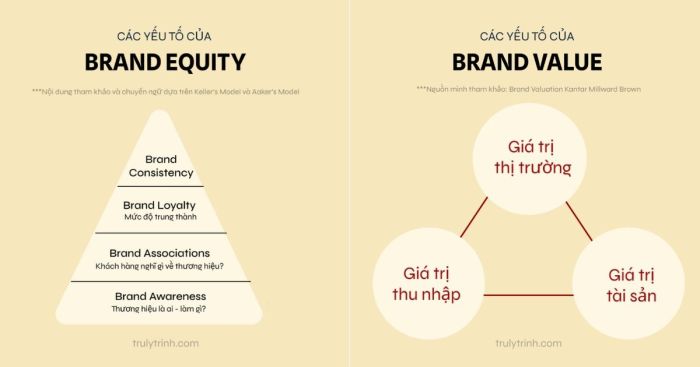
Understanding the nuances between brand equity and brand value is crucial for any organization aiming for sustainable growth. While often used interchangeably, these concepts represent distinct yet interconnected aspects of a brand’s overall strength. Brand equity reflects the intangible assets associated with a brand, encompassing consumer perception, loyalty, and awareness. Brand value, on the other hand, represents the financial worth of a brand, often calculated through complex valuation models.
This exploration delves into the key differences and similarities, examining how both contribute to a company’s overall success.
We will explore the tangible and intangible components of each, examining how factors like customer experience, brand awareness, and perceived quality influence both brand equity and brand value. Different measurement methods will be discussed, highlighting the financial and non-financial aspects crucial for a comprehensive understanding. Furthermore, we’ll investigate how these concepts vary across different industries and analyze case studies to illustrate real-world applications and their impact on financial performance.
Defining Brand Equity and Brand Value
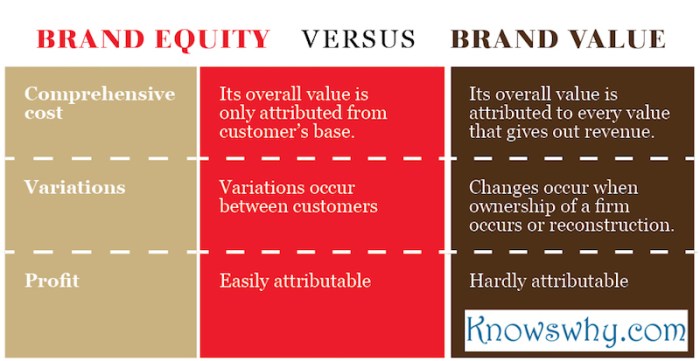
Brand equity and brand value are closely related concepts often used interchangeably, but they represent distinct aspects of a brand’s overall worth. Understanding their nuances is crucial for effective brand management and strategic decision-making. While both contribute to a company’s overall financial health, they focus on different dimensions of a brand’s impact.Brand equity is essentially the cumulative value of a brand’s assets and liabilities, reflecting its overall strength and appeal in the marketplace.
It encompasses the consumer perception, brand awareness, and loyalty associated with a specific brand. Brand value, on the other hand, is a more financial metric representing the monetary worth of a brand, often calculated based on factors like brand equity, market share, and future earning potential. It’s a direct reflection of the brand’s contribution to a company’s bottom line.
Brand Equity and Brand Value: A Comparison
The key difference lies in their measurement. Brand equity is a more qualitative measure, assessing the strength and appeal of a brand, whereas brand value is a quantitative measure representing the financial worth. Both, however, are intrinsically linked. High brand equity generally leads to high brand value, but not always. A brand might possess strong equity (positive consumer perception) but not necessarily translate directly into high financial value due to factors like market limitations or company performance.For example, Apple consistently demonstrates high brand equity due to its loyal customer base, innovative products, and strong brand image.
This high brand equity directly contributes to its substantial brand value, reflected in its high market capitalization. Conversely, a struggling company with low market share and poor consumer perception will likely exhibit both low brand equity and low brand value. Imagine a small, relatively unknown local bakery struggling to compete with larger chains; it would likely have low brand equity and therefore a low brand value.
Tangible and Intangible Aspects of Brand Equity and Brand Value
Both brand equity and brand value are built upon a combination of tangible and intangible assets. Tangible assets are easily quantifiable, while intangible assets are more difficult to measure but often hold greater value.
| Name | Description | Brand Equity Example | Brand Value Example |
|---|---|---|---|
| Tangible Assets | Physical assets that contribute to brand value, like patents, trademarks, and real estate. | Apple’s patented design for its iPhones. | Coca-Cola’s bottling plants and distribution network. |
| Intangible Assets | Non-physical assets like brand reputation, customer loyalty, and brand awareness. | Nike’s “Just Do It” slogan and association with athletic achievement. | Google’s strong brand reputation for innovation and search dominance, leading to high advertising revenue. |
| Brand Awareness | The extent to which consumers recognize and recall a brand. | High recognition of the Coca-Cola logo globally. | The high recall rate of the McDonald’s golden arches, leading to increased customer traffic. |
| Brand Loyalty | The degree to which consumers consistently purchase a particular brand. | Apple’s loyal customer base consistently upgrading to new iPhones. | Amazon’s Prime membership program fostering repeat purchases and subscriptions. |
Components of Brand Equity
Brand equity, the overall value of a brand, isn’t a single, monolithic entity. Rather, it’s built upon several key components that work synergistically to create a powerful and valuable brand. Understanding these components is crucial for businesses aiming to cultivate strong brand equity and a sustainable competitive advantage. This section will delve into the key components and explore strategies for enhancing them.
Several factors contribute to a brand’s overall equity. These components are interconnected and influence each other, creating a complex interplay that determines a brand’s overall value. A strong brand typically excels in multiple areas, while weaknesses in one area can negatively impact the others.
Brand Awareness
Brand awareness refers to the extent to which consumers are familiar with a brand and its products or services. High brand awareness translates to easier recall and recognition, increasing the likelihood of purchase. A highly aware consumer is more likely to consider a brand when making a purchase decision.
Strategies to enhance brand awareness include:
- Targeted advertising campaigns: Utilizing various media channels to reach the desired target audience.
- Public relations and media outreach: Generating positive media coverage and building brand visibility.
- Social media marketing: Engaging with consumers on relevant platforms and building brand communities.
- Content marketing: Creating valuable and engaging content that attracts and informs the target audience.
- Sponsorship and event marketing: Associating the brand with relevant events and initiatives.
Brand Loyalty
Brand loyalty represents the degree to which customers consistently choose a particular brand over competitors. Loyal customers are valuable assets, as they provide predictable revenue streams and act as brand advocates. They are less price-sensitive and more forgiving of occasional shortcomings.
Strategies to cultivate brand loyalty include:
- Exceptional customer service: Addressing customer needs promptly and effectively.
- Loyalty programs and rewards: Offering incentives for repeat purchases and engagement.
- Personalized communication: Tailoring interactions to individual customer preferences.
- Building a strong brand community: Fostering a sense of belonging and connection among customers.
- Consistent brand messaging and experience: Ensuring a cohesive brand identity across all touchpoints.
Perceived Quality
Perceived quality encompasses the customer’s overall assessment of a brand’s products or services in terms of their performance, durability, and features. This is subjective and influenced by various factors, including price, reputation, and customer experience. High perceived quality leads to higher customer satisfaction and willingness to pay a premium.
Strategies to enhance perceived quality include:
- Investing in product research and development: Creating high-quality products that meet or exceed customer expectations.
- Emphasizing product features and benefits: Clearly communicating the value proposition to customers.
- Building a strong brand reputation: Establishing credibility and trust through consistent performance and positive word-of-mouth.
- Offering exceptional customer service: Demonstrating commitment to customer satisfaction.
- Using high-quality materials and manufacturing processes: Ensuring product durability and reliability.
The Role of Customer Experience in Building Brand Equity
Customer experience (CX) is paramount in building brand equity. It encompasses all interactions a customer has with a brand, from initial awareness to post-purchase support. Positive experiences foster loyalty, positive word-of-mouth, and ultimately, higher brand equity. Conversely, negative experiences can severely damage a brand’s reputation and value.
Examples of brands excelling in customer experience include:
- Apple: Known for its user-friendly products, intuitive design, and excellent in-store and online support.
- Amazon: Provides seamless online shopping, fast delivery, and responsive customer service. Their recommendation engine also personalizes the shopping experience.
- Starbucks: Creates a welcoming atmosphere in its stores and offers personalized service, fostering a sense of community among its customers.
These brands translate superior customer experiences into higher brand equity through increased customer loyalty, positive word-of-mouth referrals, and a premium price positioning.
Measuring Brand Equity and Brand Value
Accurately assessing brand equity and brand value is crucial for effective strategic decision-making. Understanding the financial and non-financial contributions of a brand allows businesses to optimize investments, justify pricing strategies, and make informed choices regarding brand extensions or acquisitions. Various methods exist, each with its strengths and weaknesses, providing a multifaceted view of brand worth.
Brand Equity Measurement Methods
Measuring brand equity involves a combination of quantitative and qualitative approaches. These methods aim to capture the intangible assets associated with a brand, reflecting its overall strength and consumer perception.
Brand Valuation Models: These models provide a financial estimate of brand worth. They often incorporate financial data alongside brand-specific metrics. Examples include the Brand Finance method, which uses royalty relief methodology to estimate the value a brand would generate if licensed, and the Interbrand method, which assesses the financial impact of a brand’s performance.
Customer Surveys: These provide direct insight into consumer perception. Surveys can measure brand awareness, brand associations, perceived quality, and customer loyalty. Metrics such as brand recall (ability to remember the brand), brand recognition (ability to identify the brand), and Net Promoter Score (NPS) – a measure of customer loyalty and willingness to recommend – are commonly used. For instance, a survey might ask consumers to rate a brand on a scale of 1 to 10 for various attributes like quality, trustworthiness, and innovation.
Financial Statement Analysis: This method examines the financial performance of a company to infer the contribution of the brand. Analyzing revenue streams, profitability, and market share attributable to the brand can provide insights into its financial strength. For example, a comparison of the profit margins of branded versus unbranded products within a company’s portfolio can reveal the brand’s contribution to profitability.
Comparison of Brand Value Measurement Approaches
Different approaches to measuring brand value offer distinct perspectives. The table below summarizes key methods, highlighting their advantages and disadvantages.
| Method | Description | Advantages | Disadvantages |
|---|---|---|---|
| Brand Valuation Models (e.g., Brand Finance, Interbrand) | Financial models estimating brand worth based on financial data and brand-specific metrics. | Provides a concrete financial figure for brand value; useful for mergers & acquisitions, licensing, and investor relations. | Can be subjective; relies on assumptions and estimations; may not fully capture non-financial aspects of brand equity. |
| Customer Surveys | Directly measures consumer perception through surveys and questionnaires. | Provides insights into consumer attitudes, brand associations, and loyalty; can identify areas for improvement. | Can be costly and time-consuming; susceptible to sampling bias; may not directly translate to financial value. |
| Financial Statement Analysis | Analyzes a company’s financial performance to determine the brand’s contribution. | Uses readily available financial data; provides a direct link between brand and financial performance. | Difficult to isolate the brand’s contribution from other factors; may not capture the full extent of brand equity (e.g., future potential). |
| Competitive Benchmarking | Compares a brand’s performance against key competitors. | Provides context for brand performance; highlights strengths and weaknesses relative to the market. | Requires identifying appropriate competitors; may not be suitable for unique or niche brands. |
The Relationship Between Brand Equity, Brand Strategy, and Brand Management
Brand equity, brand strategy, and brand management are inextricably linked, forming a synergistic relationship where each element influences and supports the others. A well-defined brand strategy acts as the blueprint for building brand equity, while effective brand management ensures the successful execution of that strategy. Ultimately, the goal is to cultivate a strong brand that resonates with consumers and delivers tangible value to the business.Brand equity is the outcome of successful brand strategy and management.
A strong brand strategy, encompassing target audience identification, value proposition definition, and consistent messaging, lays the foundation for building positive brand associations and customer loyalty. However, the strategy itself is inert without effective brand management. Brand management encompasses all the activities involved in implementing and monitoring the brand strategy, including product development, marketing communications, customer service, and crisis management.
Effective brand management ensures consistent brand messaging across all touchpoints, fostering trust and building a strong reputation. This consistent positive experience translates directly into higher brand equity.
Brand Strategy as the Foundation for Brand Equity
A robust brand strategy is paramount. It begins with a thorough understanding of the target market, including their needs, preferences, and behaviors. This understanding informs the development of a compelling value proposition – what makes the brand unique and desirable. The strategy then Artikels how this value proposition will be communicated and reinforced through consistent messaging across all marketing channels.
For example, a luxury car brand might focus on its heritage, craftsmanship, and exclusive appeal, communicating these aspects through sophisticated advertising, premium dealerships, and exceptional customer service. Without a clearly defined strategy, brand building efforts become fragmented and ineffective, hindering the development of strong brand equity.
The Role of Brand Management in Building Brand Equity
Brand management is the active process of implementing and maintaining the brand strategy. It involves making critical decisions about product development, pricing, distribution, and promotion. Consistent execution of the brand strategy across all these areas is crucial for reinforcing brand messaging and building brand awareness. Effective brand management also involves monitoring brand performance, tracking key metrics like brand awareness, customer satisfaction, and market share.
This data provides valuable insights, enabling adjustments to the brand strategy to maintain relevance and effectiveness. For instance, a company might discover through market research that a new segment of customers is emerging, requiring adjustments to its product line or marketing message. This proactive approach to brand management ensures that the brand remains competitive and continues to build equity.
A Flowchart Illustrating the Process of Leveraging Brand Strategy to Enhance Brand Equity and Brand Value
[Imagine a flowchart here. The flowchart would start with “Define Target Market & Value Proposition.” This would branch to “Develop Brand Identity (logo, messaging, etc.).” That would then branch to “Implement Marketing & Communication Strategy.” This would further branch to “Monitor Brand Performance & Customer Feedback.” From this monitoring, there would be feedback loops leading back to “Define Target Market & Value Proposition” and “Develop Brand Identity,” indicating continuous improvement and adaptation.
Decision points would be included at each stage, such as “Is the target market being effectively reached?” or “Is the brand message resonating with consumers?” The final outcome would be “Enhanced Brand Equity & Brand Value.”] The flowchart visually represents the iterative nature of brand building, emphasizing the importance of continuous monitoring and adaptation. The process isn’t linear; rather, it’s a cycle of planning, execution, evaluation, and refinement, all aimed at maximizing brand equity and value.
In conclusion, while distinct, brand equity and brand value are inextricably linked, working in tandem to drive a company’s success. Building strong brand equity through strategic management, consistent branding, and exceptional customer experience directly translates into higher brand value and improved financial performance. Understanding the interplay between these concepts, employing appropriate measurement methods, and adapting strategies to specific industry contexts are key to unlocking a brand’s full potential and achieving long-term market leadership.
The journey to building a powerful brand requires a holistic approach, recognizing the importance of both the intangible and tangible aspects that contribute to its overall strength and value.
Commonly Asked Questions
What is the difference between brand equity and brand awareness?
Brand awareness is simply knowing a brand exists. Brand equity is the overall value and perception associated with that brand, encompassing awareness but also factors like loyalty, perceived quality, and associations.
Can a brand have high brand equity but low brand value?
Yes, a brand might enjoy strong consumer loyalty and positive perception (high equity) but have a low market capitalization or other financial metrics (low value). This could be due to factors like limited market reach or recent negative events.
How can a company improve its brand value?
Improving brand value requires a multifaceted approach, focusing on enhancing brand equity through superior customer experience, consistent messaging, strategic marketing, and innovation. Strong financial performance also directly impacts brand value.
Is brand equity more important than brand value?
Both are crucial. Brand equity is the foundation upon which brand value is built. Strong equity leads to higher value, but the actual financial worth (value) is ultimately what investors and stakeholders see.


