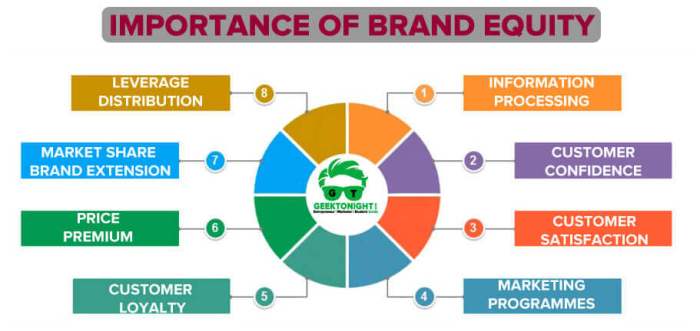
In today’s competitive marketplace, a strong brand is more than just a logo; it’s a powerful asset that drives growth and profitability. Brand equity, the intangible value associated with a brand name, represents the cumulative effect of consumer perceptions, brand associations, and loyalty. Understanding and leveraging brand equity is crucial for any marketing strategy aiming for sustainable success.
This exploration delves into the multifaceted nature of brand equity, examining its impact on various marketing decisions and demonstrating its vital role in achieving a competitive edge.
From defining the core components of brand equity—brand awareness, perceived quality, brand associations, and loyalty—to showcasing successful case studies and outlining effective measurement strategies, we will unpack the complexities of this crucial marketing concept. We’ll also analyze the relationship between brand equity and financial performance, highlighting how a robust brand can translate to increased revenue, profitability, and investor confidence.
Furthermore, we will discuss strategies for building, maintaining, and leveraging brand equity in the digital age, navigating the challenges and opportunities presented by social media, content marketing, and search engine optimization.
Defining Brand Equity
Brand equity is essentially the overall value of a brand. It’s more than just a logo or a catchy slogan; it represents the intangible assets associated with a brand name that add value to a product or service. This value stems from consumers’ perceptions, experiences, and feelings about the brand, influencing their purchasing decisions and willingness to pay a premium.
A strong brand equity translates directly into increased profitability and competitive advantage.Brand equity is built upon several core components that work together synergistically. Understanding these components is crucial for effectively managing and leveraging a brand’s value.
Brand Awareness
Brand awareness refers to the extent to which consumers are familiar with a brand and its offerings. High brand awareness implies that consumers readily recognize and recall the brand when considering relevant products or services. This recognition can be aided by strong marketing campaigns, consistent branding, and memorable brand messaging. For example, Apple enjoys incredibly high brand awareness, instantly recognizable by its logo and innovative product designs.
In contrast, a new startup in a niche market may have very low brand awareness, requiring significant effort to reach potential customers.
Perceived Quality
Perceived quality reflects consumers’ beliefs about the overall quality, reliability, and performance of a brand’s products or services. This perception is shaped by various factors, including product features, customer service, brand reputation, and price point. Brands perceived as high quality often command premium prices due to the consumer’s willingness to pay more for superior products. For instance, Rolex watches are known for their exceptional quality and craftsmanship, justifying their high price tag.
Conversely, a brand consistently producing faulty products will suffer from low perceived quality and damage its brand equity.
Brand Associations
Brand associations encompass the thoughts, feelings, and images consumers connect with a brand. These associations can be related to specific product attributes (e.g., durability, innovation), brand personality (e.g., trustworthy, playful), or even emotional responses (e.g., excitement, security). Effective branding strategically cultivates desired associations to resonate with the target audience. For example, Nike is strongly associated with athleticism, achievement, and inspiration, while Coca-Cola is linked to happiness, refreshment, and shared experiences.
Weak or negative associations, on the other hand, can severely hinder brand equity.
Brand Loyalty
Brand loyalty represents the degree to which consumers consistently choose a particular brand over its competitors. Loyal customers are less price-sensitive, more forgiving of occasional mistakes, and often act as brand advocates, recommending the brand to others. This loyalty is a significant driver of long-term profitability and competitive advantage. Apple, for example, cultivates a strong customer base with high brand loyalty, resulting in repeat purchases and a dedicated following.
In contrast, brands offering easily substituted products often struggle to build significant brand loyalty.
Case Study: The Rebuilding of Harley-Davidson’s Brand Equity
Harley-Davidson, a once iconic American motorcycle brand, faced challenges in the early 2000s with declining sales and a perception of being outdated. To rebuild its brand equity, Harley-Davidson implemented a multi-faceted strategy. This included focusing on its heritage and history, while simultaneously modernizing its product line and marketing efforts. They invested in new technologies and designs, appealing to a younger demographic while retaining its core customer base.
Furthermore, they strengthened their community engagement, fostering a sense of belonging among Harley-Davidson owners. This strategic approach successfully revitalized the brand, boosting sales and restoring its position as a leading motorcycle manufacturer. The renewed focus on brand heritage, coupled with product innovation and targeted marketing, effectively rebuilt Harley-Davidson’s brand equity.
Brand Equity and Marketing Strategies
Brand equity significantly impacts a company’s marketing decisions, influencing everything from pricing strategies to product development and distribution channels. A strong brand allows for greater flexibility and effectiveness in marketing efforts, leading to improved customer acquisition and retention. Understanding this interplay is crucial for maximizing the return on marketing investments.Brand equity influences marketing decisions across various aspects of the marketing mix.
Brand Equity’s Influence on Pricing Strategies
High brand equity allows companies to command premium prices. Consumers are often willing to pay more for products associated with a strong brand, reflecting their perceived value, quality, and trust. For instance, a luxury car brand like Mercedes-Benz can charge significantly more than a comparable car from a lesser-known brand due to its established reputation for quality and prestige. This price premium translates directly into higher profit margins.
Conversely, brands with low equity may need to rely on competitive pricing to attract customers, potentially impacting profitability. The pricing strategy must always align with the brand’s positioning and target audience.
Brand Equity’s Influence on Product Development
A strong brand provides a foundation for successful product extensions and innovations. Leveraging existing brand recognition, new product launches can benefit from increased consumer awareness and trust. For example, when Apple releases a new iPhone, it benefits from its established reputation for design and innovation, making the launch significantly easier and more impactful. Conversely, a brand with weak equity faces a more challenging launch, requiring significant marketing investment to build awareness and trust.
New product development must always consider the brand’s existing identity and values to ensure consistency and avoid diluting brand equity.
Brand Equity’s Influence on Distribution Strategies
Brand equity can influence the selection of distribution channels. Premium brands may choose exclusive distribution channels to maintain a sense of exclusivity and luxury, while brands targeting mass markets may opt for wider distribution through various retail outlets. For example, a high-end watch brand might focus on exclusive boutiques and authorized dealers, whereas a fast-moving consumer goods brand would likely use a broader network including supermarkets and online retailers.
The choice of distribution channels must always be carefully considered to maintain brand image and reach the target market effectively.
Brand Equity and Customer Attraction and Retention
Brand equity plays a crucial role in attracting and retaining customers. Strong brands build customer loyalty and advocacy, leading to repeat purchases and positive word-of-mouth marketing. Customers are more likely to choose a brand they trust and identify with, even if competing products offer similar features at a lower price. This loyalty translates into reduced customer acquisition costs and increased profitability.
Building brand equity requires consistent messaging, high-quality products or services, and positive customer experiences.
Marketing Campaign Leveraging Existing Brand Equity for a New Product Launch
Let’s consider a hypothetical scenario: Imagine a well-established coffee company, “Brewtiful,” known for its ethically sourced, high-quality coffee beans. Brewtiful wants to launch a new line of ready-to-drink (RTD) cold brew coffee. Their marketing campaign would leverage their existing brand equity in several ways:The campaign could emphasize Brewtiful’s commitment to ethical sourcing and high-quality ingredients, already established in their existing brand image.
The packaging could maintain a similar aesthetic to their existing coffee bean packaging, reinforcing brand recognition. Marketing materials could feature testimonials from existing customers, highlighting their trust and loyalty. The campaign could also utilize social media influencers who already align with Brewtiful’s brand values to promote the new RTD cold brew. Finally, loyalty programs could offer existing customers early access or exclusive discounts on the new product.
This approach uses the established trust and positive associations already linked to the “Brewtiful” brand to ensure a successful launch of the new product.
Measuring Brand Equity
Accurately measuring brand equity is crucial for understanding a brand’s performance and guiding strategic marketing decisions. A strong understanding of brand equity allows companies to make informed choices regarding investments, pricing strategies, and overall brand positioning. Various metrics and methods exist to assess this valuable intangible asset, each with its own strengths and weaknesses. This section will explore key metrics and methods for measuring brand equity.
Several key metrics provide insights into the overall health and value of a brand. These metrics can be broadly categorized into measures of brand awareness, customer perception, and market performance. Combining these metrics offers a comprehensive view of brand equity.
Brand Equity Metrics
The following table Artikels key metrics used to assess brand equity, along with their measurement methods and illustrative examples.
| Metric | Description | Measurement Method | Example |
|---|---|---|---|
| Brand Awareness | The extent to which consumers are familiar with a brand and its offerings. This can be further broken down into aided and unaided awareness. | Surveys, focus groups, online searches, social media monitoring | Aided awareness: “Have you heard of Nike?” Unaided awareness: “Which sportswear brands come to mind?” High scores indicate strong brand recognition. |
| Customer Satisfaction | A measure of how satisfied customers are with a brand’s products, services, and overall experience. | Customer satisfaction surveys (CSAT), Net Promoter Score (NPS), customer feedback analysis | A high CSAT score (e.g., 90%) and a high NPS score (e.g., 70) suggest strong customer loyalty and positive brand perception. |
| Market Share | The percentage of the total market controlled by a specific brand. | Sales data analysis, market research reports | If a company holds 30% of the market share in the cola industry, it demonstrates a strong brand position. |
| Brand Loyalty | The degree to which customers repeatedly purchase a brand’s products or services. | Customer purchase history analysis, repeat purchase rate, customer lifetime value (CLTV) calculations | A high repeat purchase rate (e.g., 70%) and a high CLTV indicate strong brand loyalty. |
| Perceived Quality | Customer perception of the quality, reliability, and performance of a brand’s offerings. | Surveys, focus groups, comparative product testing | High ratings in customer reviews and independent product tests reflect positive perceived quality. |
| Brand Associations | The attributes, benefits, and emotions associated with a brand in consumers’ minds. | Qualitative research methods like in-depth interviews, word association tests, brand personality scales | Strong positive associations with terms like “innovative,” “reliable,” and “trustworthy” contribute to high brand equity. |
Methods for Measuring Brand Equity: A Comparison
Different methods for measuring brand equity offer unique perspectives and have varying strengths and weaknesses. The choice of method depends on the specific objectives and resources available.
For example, financial methods like brand valuation models provide a monetary estimate of brand equity, which is useful for mergers and acquisitions or investment decisions. However, these models can be complex and rely on assumptions that may not always be accurate. Conversely, customer-based methods, like surveys and focus groups, offer valuable insights into customer perceptions and brand associations, but they can be subjective and time-consuming.
A balanced approach, combining multiple methods, often provides the most comprehensive understanding of brand equity.
Building and Maintaining Brand Equity
Building and maintaining strong brand equity is a continuous process requiring strategic planning and consistent execution. It’s not a one-time achievement but rather a dynamic interplay between brand messaging, customer experience, reputation management, and storytelling. A brand with robust equity enjoys higher customer loyalty, premium pricing power, and increased market resilience.Consistent Brand Messaging and Customer Experience in Building Brand Equity are crucial.
A unified brand voice across all touchpoints—from advertising campaigns to customer service interactions—reinforces brand identity and fosters recognition. Positive customer experiences, both online and offline, directly contribute to brand loyalty and positive word-of-mouth marketing. Inconsistency, on the other hand, can confuse consumers and erode trust, diminishing brand equity. For example, a company promising high-quality customer service but delivering slow response times and unhelpful interactions will inevitably damage its brand reputation.
Managing Brand Reputation and Responding to Negative Publicity
Effective reputation management is vital for safeguarding brand equity. Proactive monitoring of online reviews, social media mentions, and news articles allows for early identification of potential reputational threats. When negative publicity arises, a swift and transparent response is crucial. This may involve acknowledging the issue, apologizing sincerely (if appropriate), and outlining steps taken to address the problem.
Ignoring negative feedback can amplify the damage and severely impact brand equity. Consider the case of a company facing a product recall; a prompt and comprehensive response, including clear communication and support for affected customers, can mitigate long-term reputational harm. Conversely, a delayed or inadequate response can lead to a public relations crisis and lasting damage to the brand.
The Role of Brand Storytelling in Creating Emotional Connections with Consumers
Brand storytelling goes beyond simply conveying product features; it involves crafting narratives that resonate emotionally with the target audience. Compelling stories create a sense of connection and loyalty, differentiating the brand from competitors and fostering a deeper relationship with consumers. Effective brand storytelling leverages authenticity, values, and emotional triggers to build lasting impressions. For instance, a company might share the story of its founder’s journey, highlighting the brand’s values and commitment to its mission.
This personal touch can foster a sense of trust and connection, enhancing brand equity significantly more than simply stating product specifications. Successful storytelling often integrates the brand’s history, its mission, and its connection to the consumer’s life, fostering a strong emotional bond that translates into increased brand loyalty and advocacy.
Brand Equity and Competitive Advantage
Strong brand equity translates directly into a significant competitive advantage. It’s not just about recognition; it’s about the emotional connection a brand fosters with its consumers, influencing purchasing decisions and shaping market perception. This advantage allows companies to command premium prices, attract and retain loyal customers, and withstand competitive pressures more effectively.Brand equity acts as a powerful shield against market fluctuations and competitor actions.
A well-established brand with high equity enjoys a level of customer trust and loyalty that’s difficult for competitors to replicate quickly. This inherent advantage allows for greater resilience in the face of price wars, new product launches from competitors, and even negative publicity.
Coca-Cola versus PepsiCo: A Brand Equity Comparison
Coca-Cola and PepsiCo, two titans of the beverage industry, offer a compelling case study in contrasting brand equity. While both companies compete fiercely, their brand equity strategies differ significantly, leading to distinct market positions. Coca-Cola, with its significantly longer history and global reach, has cultivated a stronger sense of heritage and nostalgia. This translates into a more emotionally resonant brand, often associated with happiness and shared experiences.
PepsiCo, while also a globally recognized brand, has historically focused on a younger, more trend-driven demographic, often leveraging celebrity endorsements and modern marketing techniques. Coca-Cola’s brand equity, built over decades, gives it a more established and resilient market position, particularly in certain markets and demographics. PepsiCo, in contrast, maintains a strong presence through aggressive marketing and targeted campaigns, but its brand equity, while considerable, lacks the same depth and historical resonance as Coca-Cola’s.
Strong Brand Equity and Customer Attraction
Strong brand equity simplifies customer acquisition. Consumers are more likely to choose a brand they trust and associate with positive experiences, even if a competitor offers a slightly cheaper or seemingly superior product. This inherent preference reduces marketing costs and enhances conversion rates. The established reputation and positive brand perception act as a powerful draw, attracting customers organically and minimizing the need for extensive advertising campaigns to persuade them.
A strong brand effectively pre-qualifies itself, reducing the need for extensive selling efforts.
Leveraging Brand Equity for Market Defense
Several brands have successfully leveraged their brand equity to maintain their market position against competitive threats. Apple, for example, consistently commands premium prices for its products due to its strong brand association with innovation, design, and a premium user experience. This brand equity allows Apple to withstand competition from brands offering similar functionalities at lower prices. Similarly, Disney’s powerful brand equity, built on decades of storytelling and entertainment, allows it to maintain a dominant position in the family entertainment market, even facing challenges from emerging streaming services and competitors.
The brand’s inherent trust and positive associations with family values and quality entertainment effectively shield it from many competitive pressures.
Brand Equity, Brand Strategy, and Brand Management
Brand equity, brand strategy, and brand management are intricately linked, forming a synergistic relationship crucial for long-term business success. A strong brand, built on a well-defined strategy and effectively managed, translates directly into higher brand equity, which in turn drives profitability and competitive advantage. Understanding this dynamic interplay is paramount for any organization aiming for sustainable growth.Brand equity, brand strategy, and brand management are interdependent elements of a successful business model.
Brand strategy provides the roadmap, brand management executes the plan, and brand equity is the ultimate outcome – a valuable asset built over time. Each element reinforces the others, creating a positive feedback loop that enhances overall business performance.
The Interrelationship Between Brand Equity, Brand Strategy, and Brand Management
Brand equity is the culmination of consumer perceptions, associations, and feelings towards a brand. A robust brand strategy dictates how the brand will be positioned, communicated, and ultimately experienced by the target audience. Effective brand management then ensures the consistent execution of this strategy across all touchpoints, fostering the desired brand perceptions and building brand equity. Poor brand management can quickly erode even the strongest brand strategy, resulting in diminished brand equity.
Conversely, a strong brand strategy poorly executed will not fully realize its potential.
How a Strong Brand Strategy Contributes to Building Brand Equity
A strong brand strategy acts as the foundation upon which brand equity is built. It clearly defines the brand’s target audience, value proposition, brand personality, and desired brand positioning. This clarity guides all marketing and communication efforts, ensuring consistent messaging and brand experience. For example, a brand aiming for a premium positioning will invest in high-quality materials, sophisticated design, and exclusive distribution channels, reflecting this strategy in every aspect of the brand.
This consistency reinforces positive brand associations and fosters strong brand equity. Conversely, a lack of clear brand strategy often leads to inconsistent messaging and diluted brand identity, hindering the development of strong brand equity.
The Role of Brand Management in Maintaining and Enhancing Brand Equity Over Time
Brand management is the ongoing process of overseeing and protecting the brand’s image, reputation, and value. It involves monitoring brand performance, adapting to changing market conditions, and proactively managing potential threats to brand equity. This includes activities such as market research, crisis management, and consistent brand communication. For instance, a company might actively monitor social media for mentions of their brand, responding to both positive and negative feedback promptly and professionally.
This proactive approach helps to maintain a positive brand image and build customer trust, which are key components of strong brand equity. Furthermore, regular brand audits and adjustments to the brand strategy ensure the brand remains relevant and resonates with its target audience.
Illustrative Flowchart: Brand Equity, Strategy, and Management
The following flowchart illustrates the interconnectedness of these three crucial elements:
- Brand Strategy Development: Defining target audience, value proposition, brand personality, and positioning.
- Brand Strategy Implementation: Translating the strategy into actionable marketing plans and initiatives.
- Brand Management Execution: Consistent monitoring, communication, and adaptation across all brand touchpoints.
- Brand Equity Building: Positive consumer perceptions, strong brand associations, and high brand loyalty result from successful implementation.
- Brand Equity Measurement & Monitoring: Regular assessment of brand health and performance, informing adjustments to the strategy and execution.
- Feedback Loop: Insights gained from monitoring and measurement inform improvements to the brand strategy, creating a continuous cycle of improvement.
Impact of Digital Marketing on Brand Equity
Digital marketing has fundamentally reshaped how brands interact with their audiences, offering unprecedented opportunities to build and manage brand equity. The speed and reach of digital channels allow for rapid feedback, iterative improvements, and highly targeted campaigns, all crucial for cultivating strong brand recognition and loyalty in today’s competitive landscape. This section explores the key roles of social media, content marketing, and search engine optimization () in shaping brand equity, highlighting both successes and challenges.
The interconnectedness of digital marketing strategies allows for a holistic approach to brand building. A strong social media presence can drive traffic to engaging content, which in turn improves rankings, leading to increased brand visibility and ultimately, stronger brand equity. Effective integration across these platforms is key.
Social Media’s Role in Brand Equity Development
Social media platforms provide a direct line of communication between brands and their consumers. This allows for real-time engagement, feedback gathering, and relationship building, all vital components of cultivating brand loyalty and positive brand perception. Strategic social media campaigns can humanize brands, build communities around shared values, and create memorable experiences that foster strong emotional connections with consumers.
Effective use of social listening tools also allows brands to understand consumer sentiment and proactively address any negative feedback, mitigating potential damage to brand equity.
Content Marketing and Brand Equity Enhancement
Content marketing involves creating and distributing valuable, relevant, and consistent content to attract and retain a clearly defined audience — and ultimately, to drive profitable customer action. This content can take many forms, including blog posts, videos, infographics, and podcasts. By providing valuable information and engaging storytelling, brands can establish themselves as thought leaders in their industries, build trust with their audiences, and foster a sense of community.
High-quality content that resonates with the target audience can significantly improve brand recall and perception, leading to a stronger brand equity.
Search Engine Optimization () and Brand Visibility
Search engine optimization () focuses on improving a website’s visibility in organic search engine results. By optimizing website content and structure for relevant s, brands can attract more organic traffic from search engines like Google. High rankings for relevant search terms increase brand visibility, driving more potential customers to the brand’s website and other online properties. A strong strategy contributes significantly to brand awareness and recall, both key factors in building brand equity.
Examples of Successful Digital Marketing Strategies
Nike’s consistent use of social media to showcase athlete endorsements, user-generated content, and inspiring stories has cultivated a strong and aspirational brand image. Their digital marketing campaigns effectively connect with their target audience on an emotional level, enhancing their brand equity. Similarly, Dove’s “Real Beauty” campaign, heavily reliant on digital channels, successfully challenged conventional beauty standards and fostered a positive brand association with self-acceptance and body positivity.
This campaign resonated deeply with consumers, strengthening their brand equity significantly.
Risks and Challenges of Digital Marketing
While digital marketing offers immense opportunities, it also presents significant risks. Negative online reviews, social media crises, and the spread of misinformation can quickly damage a brand’s reputation and erode its equity. The ever-evolving digital landscape requires constant adaptation and investment to remain competitive and avoid being left behind. Furthermore, measuring the true return on investment (ROI) of digital marketing efforts can be complex, requiring sophisticated analytics and tracking mechanisms.
Finally, the ethical considerations surrounding data privacy and targeted advertising must be carefully managed to maintain consumer trust and avoid reputational harm.
Ultimately, building and maintaining strong brand equity is an ongoing process that requires a strategic and holistic approach. By understanding the key components of brand equity, implementing effective measurement techniques, and adapting to the evolving digital landscape, businesses can cultivate a powerful brand that resonates with consumers, drives sales, and ensures long-term success. A well-defined brand strategy, coupled with consistent brand messaging and exceptional customer experiences, forms the cornerstone of a thriving brand and a sustainable competitive advantage in the marketplace.
Investing in brand equity is not merely an expense; it’s a strategic investment in the future of the business.
FAQ Compilation
What are some common mistakes companies make when building brand equity?
Common mistakes include inconsistent messaging, neglecting customer feedback, failing to adapt to changing market trends, and overpromising and underdelivering.
How long does it take to build significant brand equity?
Building significant brand equity is a long-term process that varies depending on the industry, target market, and marketing efforts. It can take years of consistent effort and investment.
Can negative publicity completely destroy brand equity?
While negative publicity can severely damage brand equity, it doesn’t always lead to complete destruction. A well-managed crisis response and a commitment to rebuilding trust can mitigate the damage.
How can small businesses build brand equity on a limited budget?
Small businesses can leverage cost-effective strategies such as building a strong online presence, focusing on exceptional customer service, and creating engaging content marketing.


